Ithaca & Mission Statements
mission statements don’t matter. until they do

I referenced self-inflicted “mission-aligned” problems in the last Ithaca piece and moved on because it all seems so obvious. But … maybe it’s not.
Most higher ed mission statements don’t matter, because most of them are some version of “we sell education.” Such statements reflect a credo of market-alignment.
Previously in College Mission Statements Determine Financial Structures – a boring yet critical piece – I demonstrated that mission statements define financial structures; how many mission statements are reviewed and scored by the CFO and CMO of a college? I’d guess the answer to that is zero.
In the cases where the mission statement boils down to “we sell education” – at all comprehensive public colleges, for example – the CFO’s input may not matter only because everyone implicitly understands the market-aligned mission.
But at “mission driven” colleges, such mission statements have significant repercussions.
What if your mission doesn’t align with the market? Have you modeled the risk? Have your marketing and admissions people provided a demographic assessment to the CFO to evaluate the potential cost of being ‘mission aligned?’ Such missions are always high-risk compared to the mission of comprehensive colleges; are the trustees aware of this risk? Are the alumni, faculty and community supportive, despite the potential hazards?
Or did everyone fly blind into the mission and learn the hard way that your mission wasn’t market-aligned?
The most obvious “mission driven” colleges are probably arts colleges (RISD, Ringling, etc). They are very aware that their mission and the market have a fraught relationship, and they occasionally watch their peers implode (Notes from an Autopsy: University of the Arts). Being mission-aligned to any serious degree is usually a high-wire act.
This is what’s so bizarre about Ithaca College. It’s almost as if the administration didn’t think any of this through.
Ithaca’s brand destruction began around 2009 (Biopsy: Ithaca College). The college never fully recovered. But over the last ten years, Ithaca has engaged in a new round of brand destruction. And that brand destruction is fundamentally driven by market-misalignment.
Had Ithaca asked a decade ago (or even in 2019 when it published its last strategic plan) whether there was a market for its mission, the answer would have been ‘yes – but it’s about 30% smaller than the college’s current financial structure requires.’
Arts colleges live and breath this problem, and it seems incredibly obvious. But somehow, Ithaca missed it (though Ithaca isn’t alone – New School missed it too.)
Ithaca’s Market
Ithaca’s primary market is suburban kids from Philadelphia to Boston. Good kids, good students, and parents who can write checks. None of that is a mystery; it’s the primary market for nearly every competitive private college from Maine to Miami. Competitive private colleges in Florida typically derive 50%-80% of their revenue from that same Philly to Boston market. From Bates and Bowdoin to Rollins and the University of Miami … RISD and Drew and Dickinson and Emory … all of them rely heavily on students from the same geographic region.
And the college-age population in that region hasn’t shrunk from 1990-2020. Most years, it grew. I’d guess that it’s those kids who aren’t buying the mission. And that’s something that should have been obvious at least seven years ago.
Finances vs. Brand
Ithaca’s finances aren’t terrible (well, they are, but comparatively many colleges have worse finances).
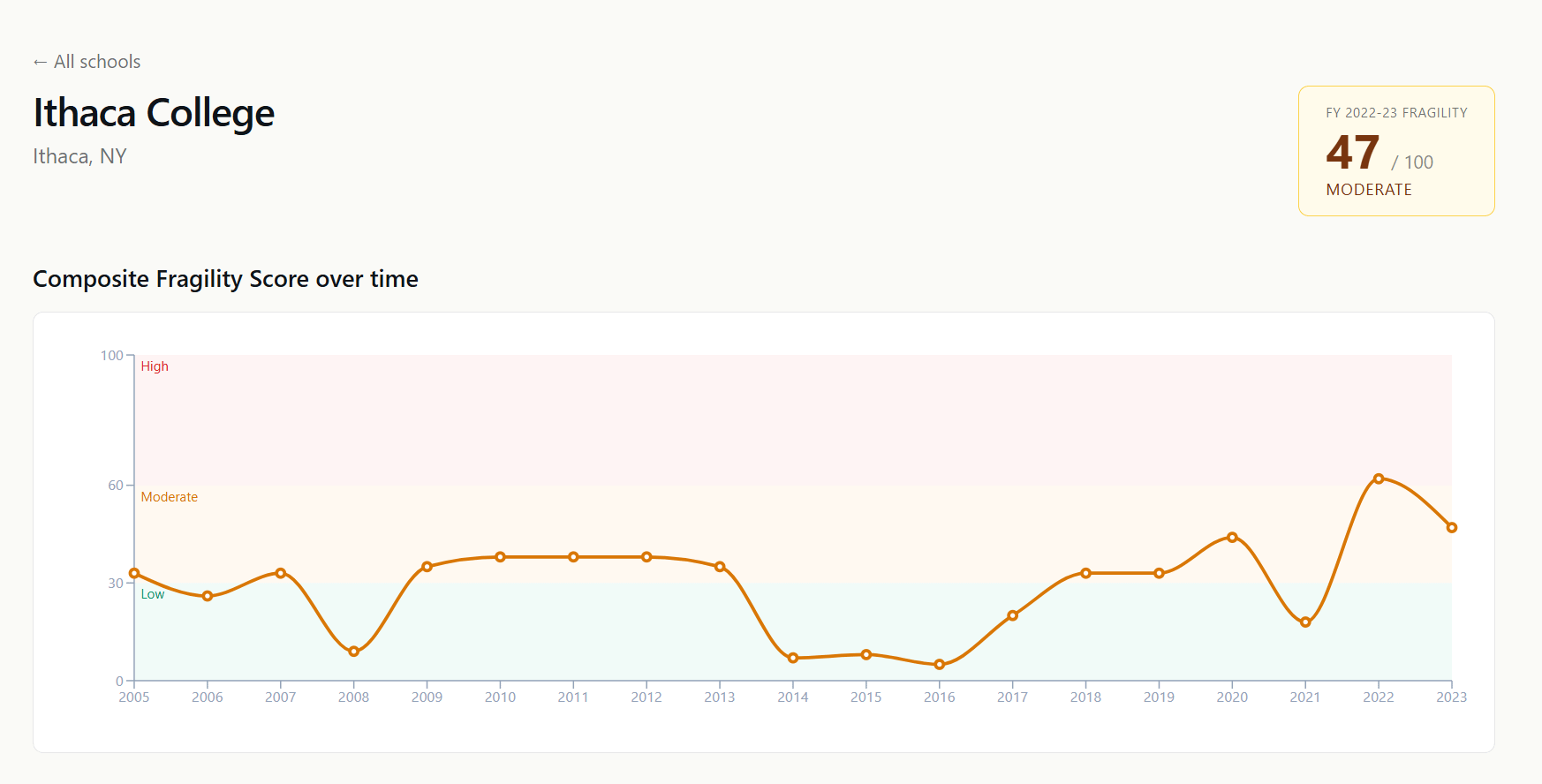
The most lethal move any college can make is to load up on debt, and Ithaca didn’t do that to a lethal degree. That means that – generally – Ithaca’s problems are financially survivable. But note the drop in pricing power:
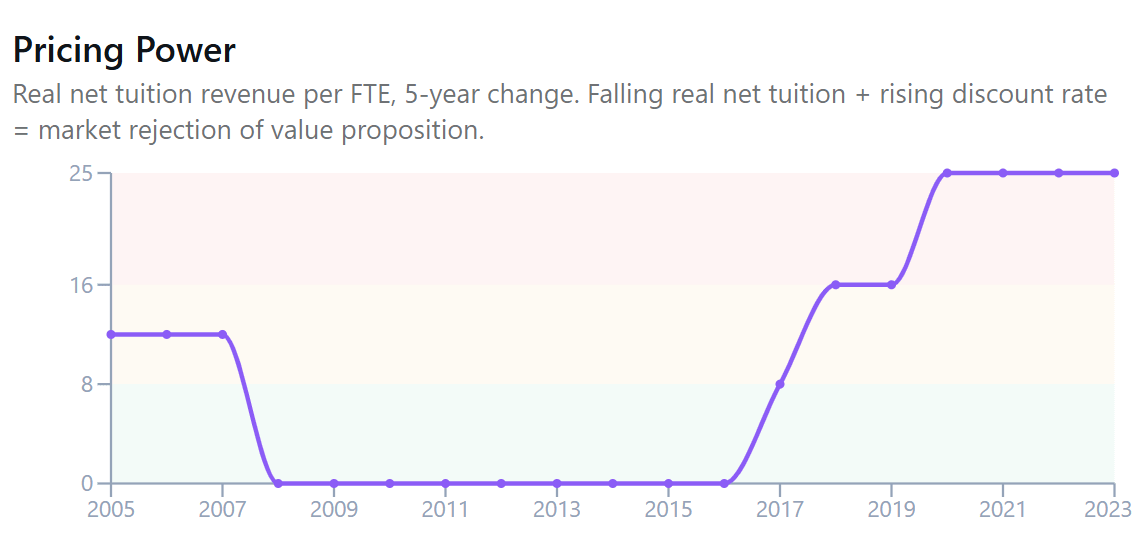
For a decade, Ithaca had moderate to good pricing power (which is a market-derived brand desirability signal). But that pricing power has been on a one-way slide since 2017. This suggests the issue is product-market fit.
Students are increasingly using AI for their college exploration and selection, so let’s investigate how AI views and communicates Ithaca’s pricing power as represented by their perceived and communicated brand. We approach AI agents from a range of prospect personas who are choosing between Ithaca and another college. A few results:
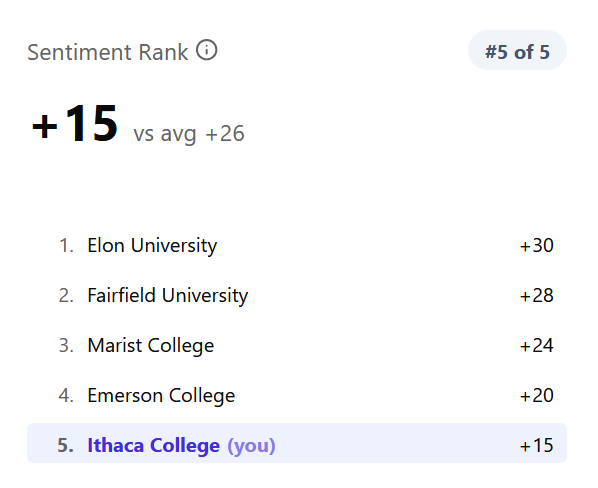
When compared to this group of colleges, Ithaca’s brand ranks last (this is what AI agents are communicating to prospects). Let’s investigate specific head-to-head comparisons:
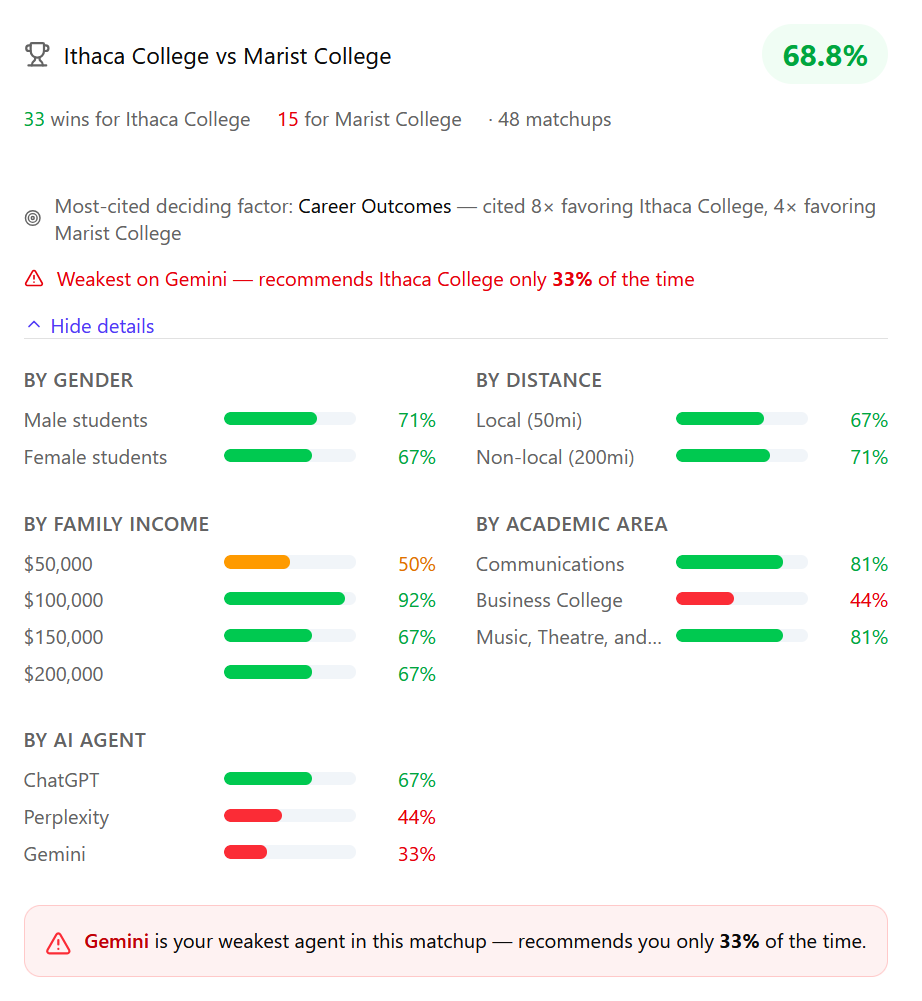
Ithaca generally does well across all AI agents, but it should be disconcerting that one of the two major AI agents (Gemini in this case) recommends Ithaca so infrequently compared to Marist. It should also be disconcerting that the business college is the biggest drag on sentiment (of the assessed academic areas – I didn’t assess every area).
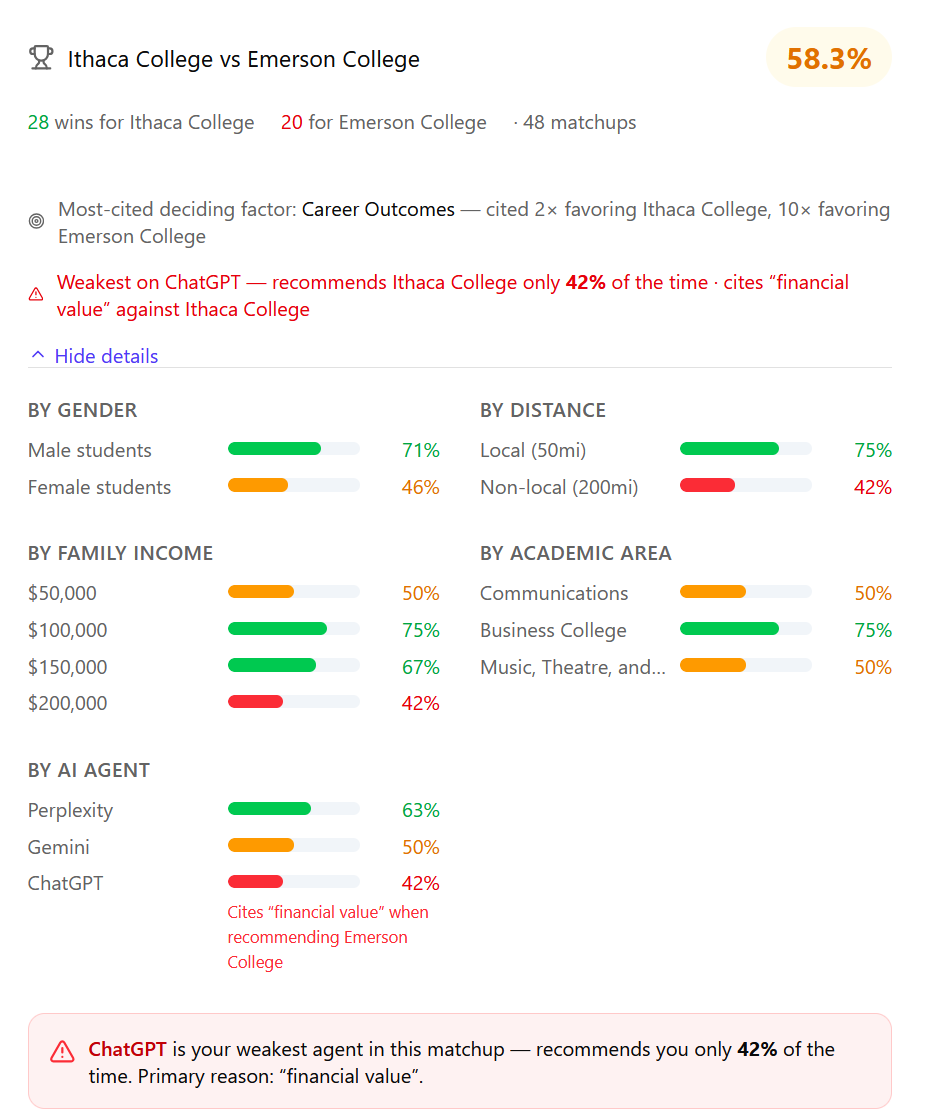
And here, we see Ithaca getting a minority of recommendations from the other major AI agent, ChatGPT. We may also observe the strong gender-bias versus Emerson. (I could keep going with these data … it’s rather endless. But this is the sort of market data one finds with Ithaca everywhere one looks.)
These are all very solvable brand issues but solving that market pricing problem doesn’t happen miraculously. You actually need to dig into the data and start solving. Reviewing the email-content table from the last Ithaca article, it doesn’t appear that work is being done.
Two Greater Cautions
If I were a trustee, my issues would be two-fold.
First, Ithaca absolutely cannot rely on revenue projections. That’s how you got into this problem in the first place. Your outgoing CFO said that his “projections are partly predicated on the college hitting its enrollment targets.” That’s the kind of talk that should keep the trustees awake at night.
Second, the people who got Ithaca into this problem aren’t going to get the college out of this problem. The old political axiom that “policy isn’t policy … people are policy” applies here.
It may not be optimal to have 6,500 students (from a capacity utilization perspective), but there’s nothing in the data that suggests that Ithaca shouldn’t or can’t have 6,500 students … with a market-aligned mission.
Back in 2008-09, Ithaca shot itself in the foot. Then, about a decade ago, it shot itself in the other foot. You’d think that Ithaca would then find its way to an E.R. but instead we get interviews from the president that amount to “we’ll be fine as long as we don’t shoot ourselves in our third foot.”
It’s some kind of delusion, some Theranos, WeWork, Juicero.
Ithaca in many ways avoided the type of debt intake you discuss by having its largest ever capital campaign in the first decade of this century. It concluded during my freshman year, and its outcomes produced the new business school building, the Athletics & Events Center, and an administrative office building lampooned as an ivory tower as it was being built.
There is no denying the importance of the Athletics & Events Center (and Ed Glazer ‘92 deserves all aplomb for his donation and efforts to get it finished). The athlete-to-non-athlete ratio has only grown since my graduation. That said, as I lamented at the time, it didn’t reduce the reliance of athletics on the Hill Center and Ceracche Center enough. Two antiquated buildings still needed immediate renovations in the following decade.
The A&E Center has also never delivered the alternative revenue streams promised. The most noteworthy outside event it has ever attracted was the 2019 concert of 77-year-old Bob Dylan. New York high school championship events in T&F, S&D, or NCAA D3 equivalents still, predictably, stay away. The facility is almost 15 years old now and will never create those outside revenue streams.
I don't think I need to go further on the Business School building, which Dorothy Park is likely rolling in her grave over as the Park School of Communications, one of IC’s true gems, faces massive budget reductions in the next two academic years.
Then there is Tom Rochon’s ivory tower. His safe hideaway to conduct presidential business away from those masses of students who paid more and more as their actual gross population dwindled.
Pres. Collado made things worse, and LJTC I’m sure is spending more and more time up in that presidential suite.
IC needs a hard reboot in hopes that the harddrive has not already been permanently damaged beyond repair.
The trustees meet this week May 14-16. A negotiated, amicable departure at the end of the fiscal year for Pres. LJTC should be in place by the end of that session.
If an agreement can not be reached, the BOT should enjoy attending commencement, and then return to session Sunday night and terminate the president (without cause or malice; I do believe TLJC has tried her best, but she was a woefully unqualified provost hired by the College’s most toxic president. Barring new information, she should be paid out, thanked for her service, lackluster though it was, and there should be a clean break).
She has indicated she will not serve as a lame duck, and nobody gains from allowing her to do so in 2026-27.
I don't know the current makeup of the elected faculty bodies at IC, but I know there are faculty members who read this substack. If there was ever a time to put pressure on this crumbling administration and take steps to save the College from becoming Wesley or Wells, Cazenovia or St. Rose, or any of the other institutions that waited too long believing business as usual would return, the time is now.